Printable Couples Conflict Workbook: Listen, Agree, Reconnect
What Changes When Conflict Gets a Structure
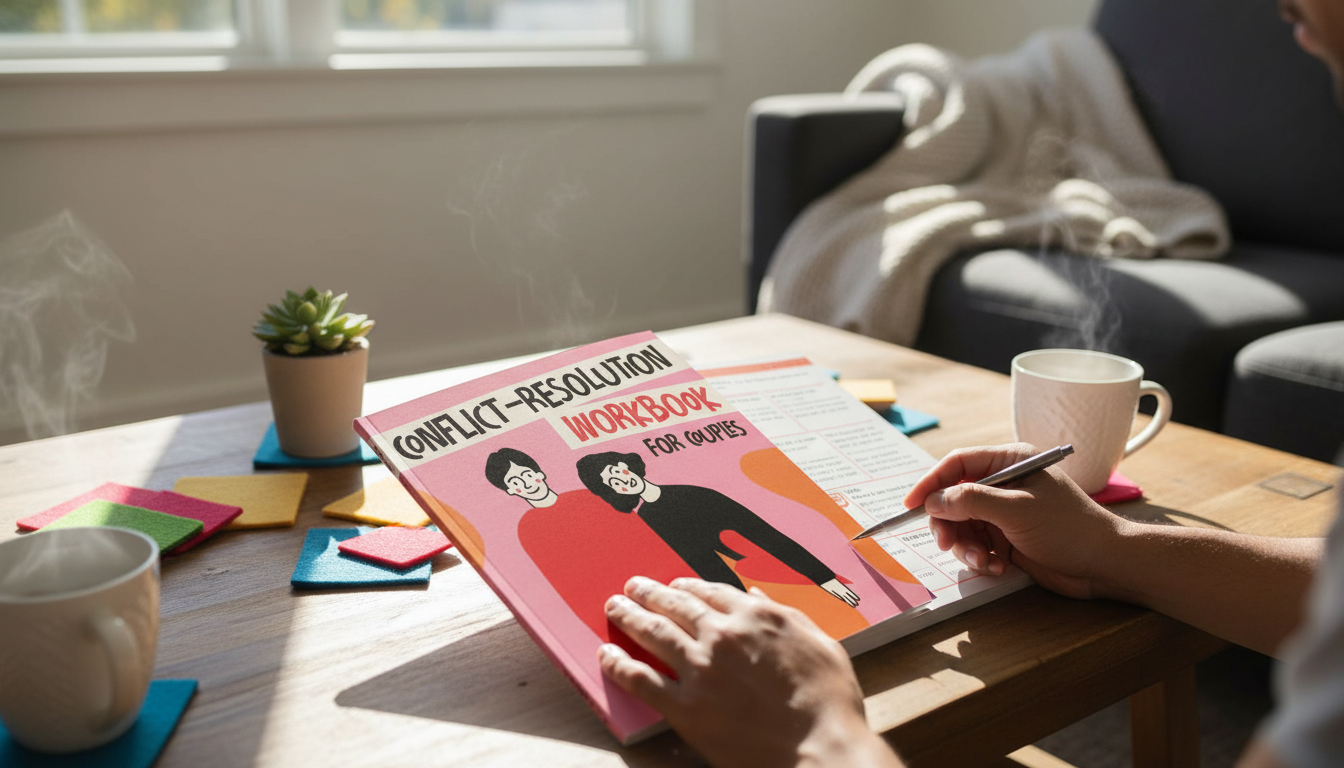
Most recurring arguments aren’t really about “the dishes” or “the budget.” They’re about what happens inside the conversation: one partner escalates to be heard, the other shuts down to stay safe, and both walk away feeling more alone. Adding structure—clear steps, a shared vocabulary, and time boundaries—can shift conflict from a threat response to a problem-solving mode.
When couples use a repeatable process, it often leads to four practical changes:
- Fewer fight-or-flight reactions: Time limits and step-by-step pages slow the pace so your nervous system can catch up.
- Shared language for sensitive topics: Words like “trigger,” “need,” “boundary,” and “repair attempt” make hard conversations less personal and more workable.
- The problem stops being the person: Feedback becomes about a specific behavior or pattern—not a character verdict.
- Consistency across topics: The same method can be reused for money, intimacy, in-laws, parenting, chores, and emotional support.
What a Conflict-Resolution Workbook for Couples Should Include
A strong printable workbook doesn’t just tell you to “communicate better.” It gives you a plan for what to do when you’re triggered, what to say when you’re stuck, and how to reconnect after a hard moment.
- A quick pause plan: Simple time-out rules, a return time, and self-soothing ideas so the break doesn’t feel like abandonment.
- Active listening prompts: Reflection, validation, and clarifying questions to reduce misinterpretation.
- A way to uncover the real issue: Pages that identify values, fears, and unmet needs beneath the surface argument.
- Repair tools: Scripts for apologies that land, reassurance, and next-step agreements.
- Tracking pages: Space to notice triggers, cycles, and what actually helps over time.
Helpful Workbook Components and When to Use Them
| Workbook tool | Best time to use | What it helps prevent |
|---|---|---|
| Time-out and return plan | As soon as voices rise or either partner shuts down | Saying things that can’t be unsaid |
| Listening prompts (reflect/validate/ask) | Early in the conversation | Talking past each other |
| Needs and boundaries worksheet | When the topic keeps looping | Hidden expectations and resentment |
| Solution brainstorm + agreement | After both feel understood | Vague promises and repeat fights |
| Repair and reconnection page | Within 24 hours of conflict | Emotional distance and lingering mistrust |
If you want a ready-to-print system that includes these pieces in one place, see the Conflict-Resolution Workbook for Couples (printable relationship communication eBook).
A Simple “Weekly Reset” Routine Using Printable Pages
Big relationship improvements often come from small, predictable check-ins. A weekly reset works best when it’s short, specific, and emotionally safe.
- Set a predictable window: 20–40 minutes when neither partner is rushed, hungry, or half-asleep.
- Start with a quick check-in: Stress level, top concern, and one appreciation each.
- Choose one issue only: Park the “and another thing…” topics for later so you don’t pile on.
- Use timed turns: Each partner speaks without interruption, then switches.
- End with a testable agreement: Decide what will happen, who will do it, by when—plus a follow-up date.
For a science-backed overview of what helps couples manage conflict more effectively, the American Psychological Association offers practical guidance on managing conflict in relationships.
Improve Listening Without Agreeing With Everything
Listening well doesn’t mean surrendering your viewpoint. It means creating enough emotional safety that both people can stay present long enough to solve the actual problem.
- Reflect first: Repeat back the meaning (not the exact words). “So you’re saying you felt dismissed when I looked at my phone.”
- Validate emotions: Acknowledgment is not approval. “That makes sense you’d feel hurt,” can coexist with “I see it differently.”
- Ask what support would help: “What would feel supportive right now?” moves the focus from blame to need.
- Name the cycle: If you recognize criticize/defend, pursue/withdraw, or fix/avoid, label it and return to the steps.
- Replace absolutes with specifics: Swap “always/never” for one event and one request.
Resolving Arguments: From Stuck Positions to Real Agreements
It can also help to learn what “repair attempts” look like in real time—small phrases or gestures that de-escalate and reconnect. The Gottman Institute explains this skill clearly in its overview of repair attempts.
Rebuilding Trust After Repeated Conflict
If you ever worry that conflict is crossing the line into emotional or physical abuse, consult the National Domestic Violence Hotline warning signs page for guidance on what to watch for and how to get support.
Printable Relationship Communication eBook: How to Get the Most From It
Explore the printable tools here: Conflict-Resolution Workbook for Couples | Printable Relationship Communication eBook | Improve Listening, Resolve Arguments, Rebuild Trust.
If you’re dating (or re-entering dating) and want a structured way to communicate who you are from the start, the Online-Dating Profile Blueprint can help you create clearer profiles and more intentional first conversations.
FAQ
Can a conflict-resolution workbook help even if only one partner is motivated at first?
Yes—one partner can model the structure by using time-outs, reflecting what they heard, and making clear, specific requests. Start with one small agreement that reduces friction, and invite participation gradually; if the other partner refuses all engagement consistently, progress will be limited.
What if every conversation turns into the same argument?
Use worksheets to identify the repeating trigger and the cycle you fall into, then narrow the discussion to one topic and one request. A pause-and-return rule plus written prompts can keep the conversation from drifting back into familiar blame patterns.
Is a printable workbook a substitute for couples therapy?
It can build skills and add structure, but therapy may be necessary for chronic distrust, infidelity recovery, trauma, or situations where communication becomes harmful or unsafe. When you can’t de-escalate reliably or the conflict feels scary, professional support is often the safest next step.











Leave a comment