Talk & Connect Workbook: Better Parent-Child Talks

Talk & Connect: A Practical Workbook for Better Parent–Child Conversations
When daily life gets busy, meaningful conversations can shrink to quick check-ins, reminders, and “Did you do your homework?” moments. A simple, repeatable routine—built around small questions, emotion words, and steady listening—can make it easier for kids to open up and for parents to respond with more calm than urgency. The goal isn’t perfect communication; it’s creating enough safety and consistency that honesty shows up more often.
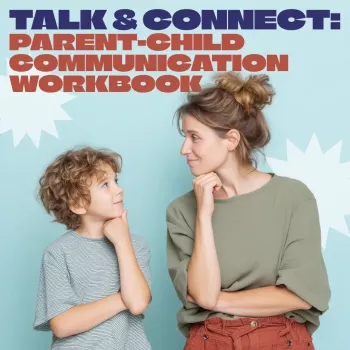
This practical approach works especially well when families use a structured workbook to reduce decision fatigue and keep progress visible over time. If you want a ready-to-use format, Talk & Connect: Parent-Child Communication Workbook – Positive Parenting Guide for Stronger Family Bonds, Conversation Starters, and Emotional Connection is designed for short, repeatable check-ins that help parents and kids feel more “on the same team.”
Why communication breaks down even in loving families
- Stress and time pressure push conversations toward logistics instead of connection (schedules, chores, fixes).
- Kids often share indirectly through behavior, silence, or short answers rather than clear words—especially after a long school day.
- Parents may default to fixing, lecturing, or questioning too fast, which can accidentally make a child feel judged or cornered.
- Different temperaments and ages need different pacing; what works for a chatty 8-year-old can overwhelm a private 13-year-old.
- Small misattunements stack up; consistent micro-repairs rebuild trust faster than an occasional “big talk.”
Relationship science often describes healthy communication as a back-and-forth loop: a child offers a “serve” (even a tiny one), and an adult responds in a way that fits. Harvard’s Center on the Developing Child explains how this “serve and return” pattern supports connection and emotional growth: https://developingchild.harvard.edu/science/key-concepts/serve-and-return/.
What a communication workbook adds (beyond good intentions)
- Ready-to-use conversation starters reduce the pressure to “say the right thing.”
- Guided reflection helps parents notice patterns (triggers, tone, timing).
- Emotion-naming tools expand a child’s vocabulary beyond “fine” or “mad.”
- Repeatable exercises make progress measurable and more motivating.
- A shared format creates predictability, which helps kids feel safer opening up.
Common hurdles and workbook-style solutions
| Hurdle | What it can look like | Workbook approach to try |
|---|---|---|
| Short answers | “Nothing” / “I don’t know” | Low-pressure prompts and multiple-choice feelings check-ins |
| Big emotions | Meltdowns or yelling | Co-regulation scripts, pause cues, and debrief questions after calm returns |
| Defensiveness | Arguing or blaming | Reflect-and-validate steps before problem-solving |
| Avoidance | Changing the subject | Micro-conversations (2–5 minutes) with a predictable start/end |
| Hard topics | School stress, friends, mistakes | Gentle story-based prompts and “what would you do if…” questions |
How to use Talk & Connect for a weekly routine (10–15 minutes)
A routine is more effective than a one-time heart-to-heart. Keep it short, keep it consistent, and end while it’s still going well.
- Pick a consistent time: after dinner, bedtime, or a weekend morning.
- Start with a warm opener: one appreciation or “best part of today” from each person.
- Use one prompt only: don’t stack questions; leave some curiosity for next time.
- Mirror first: reflect back what you heard before asking a follow-up.
- Close with a small plan: one supportive action the parent will do this week (ride to practice, quieter bedtime, extra one-on-one time).
- Track one win: any moment of honesty, calm, or repair counts as real progress.
For younger kids, the “win” might be naming a feeling instead of storming off. For older kids, it might be sharing a detail they usually keep private.
Conversation starters that build trust (without feeling like an interview)
Trust grows when questions feel like genuine curiosity—not a cross-examination. Use a gentle tone, allow pauses, and accept “I don’t know” as a starting point rather than a dead end.
If you’d like a consistent set of these, Talk & Connect organizes conversation starters and reflection space so you’re not reinventing the wheel when you’re tired.
Helping kids name emotions and needs
For additional guidance on age-appropriate parenting tools and routines, the CDC’s Essentials for Parenting offers practical, research-informed strategies: https://www.cdc.gov/parents/essentials/index.html.
When conversations get heated: a calm repair script
For support navigating sensitive subjects in a developmentally appropriate way, the American Psychological Association shares helpful guidance: https://www.apa.org/topics/parenting.
Who this workbook supports best
Get started with Talk & Connect
- New Puppy Training Starter Guide | Printable Puppy Training eBook for Beginners | 4-Week Puppy Routine, House-Training, Commands, Socialization & More (for households adding a new pet and trying to reduce chaos).
- The Smart Traveler’s Guide to Global Etiquette | Digital Download eBook for Cultural Tips, Travel Etiquette, and International Manners (useful for families preparing kids for travel, visits, or cultural expectations).
FAQ
What age is this communication workbook best for?
It works well for elementary-age kids through teens, with small adjustments: use simpler feeling choices and shorter sessions (5–10 minutes) for younger kids, and more open-ended prompts plus privacy-respecting pacing for tweens and teens.
What if my child refuses to talk?
Lower the pressure by offering choices, doing side-by-side activities (a walk, drawing, driving), and starting with 2–5 minute check-ins. Focus on reflecting and validating first—often the words come later when your child feels understood.
How often should parents use the prompts?
A realistic cadence is 2–4 short check-ins per week or one slightly longer weekly conversation. Consistency matters more than length, and it helps to stop while the conversation is still going well.











Leave a comment